

The Factual Summary report on “The public consultation on Evaluation of the Public Procurement Directives” was published on 20 May 2025, which presents the exploratory findings from a public consultation.
The European Commission, specifically the DG for Internal Market, Industry, Entrepreneurship and SMEs. The Factual Summary report itself was drawn up while the Commission was working on a comprehensive evaluation report.
The report was published to present the exploratory findings of the public consultation on the evaluation of the Public Procurement Directives. This public consultation was conducted to gather in-depth and high-quality evidence, information, data, and feedback on how Directives 2014/23/EU, 2014/24/EU, and 2014/25/EU have performed, and to assess whether they are still fit for purpose to achieve EU policy objectives.
The Factual Summary report serves as a preliminary analysis of the results from this consultation. It is published as part of a broader evaluation process aimed at assessing the effectiveness, efficiency, relevance, coherence, and EU added value of these directives, providing an initial compilation of stakeholder feedback.
Background
Public Procurement in the EU Public authorities across the EU spend over EUR 2.4 trillion annually on purchasing services, works, and supplies, which accounts for around 14% of the EU’s GDP. To ensure a level playing field for businesses across Europe and govern how public authorities and certain utility operators purchase goods, works, and services above certain values, the EU has set out minimum public procurement rules.
The Three Directives Under Evaluation: The evaluation is specifically focused on three legislative acts that regulate public procurement in the EU. These are:
- Directive 2014/23/EU on the award of concession contracts
- Directive 2014/24/EU on public procurement
- Directive 2014/25/EU on procurement by entities operating in the water, energy, transport and postal services sectors.
These directives cover procedural rules (‘how to buy’), including general rules, specific rules for utility sectors (water, energy, transport, postal services), and rules on concessions. The evaluation covers the period from 2016 to 2024 and includes all EU Member States and EEA countries.
Purpose of the Evaluation
The evaluation aims to assess the performance and impact of these three directives across the EU. It seeks to determine whether they remain fit for purpose, achieve their intended objectives at minimum cost, and are adequate to address current challenges. Specific objectives being assessed include their contribution to a high level of competition, increased participation of SMEs, simplification and flexibility of procedures, transparency and integrity, efficient use of public funds, and making the EU a greener, more social, and innovative economy.
The evaluation is also linked to broader EU goals and challenges identified in various reports and political guidelines, such as addressing decreasing competition, using public procurement as a tool for EU objectives, and potentially revising the directives to enable preference for European products in strategic sectors, ensure security of supply, and simplify rules for start-ups and innovators.
The Public Consultation
The public consultation is a key consultation activity for this evaluation, held online alongside a call for evidence. Its aim was to collect in-depth evidence, information, data, and feedback on how the three directives have performed. The consultation received 733 responses from a broad range of stakeholders. The most represented groups were:
- Public authorities (27% – 199 replies)
- Companies and businesses (20% – 150 replies)
- Business associations (16% – 119 replies)
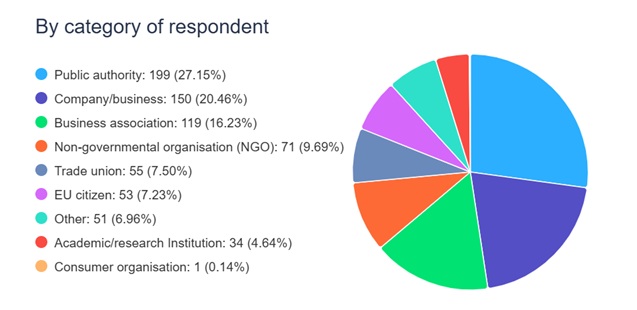
Other respondents included NGOs, trade unions, EU citizens, academic/research institutions, and consumer organizations. Replies came from various EU member states (most from Germany, Belgium, France, Spain) and some non-EU countries.
Among public authorities, responses came from local (46%), national (29%), regional (19%), and international (6%) levels. Business responses included large (60%), medium (16%), small (9%), and micro (15%) businesses.
Key Findings
Procedural Simplicity and Flexibility: Many respondents felt the directives had not significantly improved procedural simplicity (54% think they did not establish simpler rules) or flexibility (49% believe they did not make the system flexible enough).
Digitalisation (eProcurement): Digitalisation was broadly seen as helping to reduce administrative burdens (42% agree) and potentially making procurement faster (38% agree). Companies/businesses were notably more positive about these benefits than public authorities.
Transparency and Integrity: Generally viewed positively. 62% of respondents agree that the directives have increased transparency. 38% believe they have helped to reduce corruption. Rules on EU-wide publication via TED are considered still relevant and adequate by 48%.
Competition and Market Access: Doubts were raised about the directives’ effectiveness in fostering competition. Many respondents (46%) disagree that the directives have resulted in more competition. 38% of respondents consider the level of competition too low. The frequency of awards based on price only is considered too high by nearly half of the respondents (49%).
Equal Treatment and Cross-border Participation: Most respondents (53%) believe the directives ensure the equal treatment of bidders from other EU countries. However, only 38% consider that the directives have made it easier to bid on public contracts from abroad, and public authorities tend to disagree with this. Rules on eProcurement are seen as relevant for facilitating market access by almost half of respondents (49%).
Strategic Goals (Green, Social, Innovation): Views are mixed. While public authorities tend to agree the directives encouraged strategic buying (green, social, innovative), other respondent groups, particularly businesses, disagree. More respondents overall disagree than agree that the directives encouraged companies to make greater efforts in meeting environmental standards, considering social aspects, and using innovative solutions. Views on the relevance of specific rules for supporting strategic procurement are also mixed or slightly negative.
Relevance: Views are mixed. Rules aiming at procedural flexibility are considered no longer relevant or adequate by 48%. Conversely, rules on transparency are considered still relevant and adequate by 48%. Rules on market access for non-EU companies are considered less relevant (only 16% find them relevant/adequate).
Coherence: Most respondents (39%) believe the objectives of the three Public Procurement Directives are coherent with each other. However, a larger proportion (37%) do not think that EU legislation relating to public procurement (e.g., sectoral rules) is coherent with these directives.
Resilience and Strategic Autonomy: Many respondents (49%) disagree that the directives are fit for purpose to contribute to the EU’s strategic autonomy, including supply chain security. Concerns were also raised about their fitness for purpose in urgent situations or major supply shortages.
Comparison with Other Procurement: Compared with procurement below EU thresholds, conducting transactions under the directives is often considered less simple, slower, and less flexible. Similarly, compared with private procurement, it is often seen as less simple, faster, and subject to less competition. However, compared with private procurement, transactions under the directives are considered more transparent, fairer, and better at preventing corruption by some respondents.
Conclusion
The Factual Summary report provides a preliminary analysis of the extensive feedback received during the public consultation on the evaluation of the Public Procurement Directives. The findings reveal mixed views across different stakeholder groups and various aspects of the directives, including significant concerns regarding procedural simplicity, flexibility, competition, and the effectiveness in fostering strategic goals and resilience. These findings will contribute to the comprehensive evaluation report being prepared by the Commission.
Pls find the Report Here.


একটি ভাইরাল পণ্যের উত্থান-পতন: Labubu সাপ্লাই-চেইন কেস স্টাডি
চীনের বিখ্যাত খেলনা কোম্পানি পপ মার্ট (Pop Mart)-এর Labubu নামের একটি খেলনাটি সাম্প্রতিক বছরগুলোতে বৈশ্বিক ভোক্তা আচরণ, ডিজিটাল মার্কেটিং এবং

e-GP টেন্ডারে TEC সদস্যদের Declaration কি হার্ডকপিতে আলাদা দিতে হবে ?
সরকারি টেন্ডারে সরকারি ক্রয় বিধিমালা মোতাবেক দরপত্র মূল্যায়ন কমিটি (Tender Evaluation Committee – TEC) গঠন করতে হয়। এই কমিটি দরপত্র মূল্যায়ন
দরপত্র মূল্যায়নে TEC সদস্যদের কতগুলো ঘোষণা (Declaration) দিতে হয় ?
সরকারি টেন্ডারে সরকারি ক্রয় বিধিমালা মোতাবেক দরপত্র মূল্যায়ন কমিটি (Tender Evaluation Committee – TEC) গঠন করতে হয়। এই কমিটি দরপত্র মূল্যায়ন

Specification Trap: Lessons from the DYKA Case
Technical specification determination in public procurement is a highly sensitive matter because it dictates how open or restricted competition will