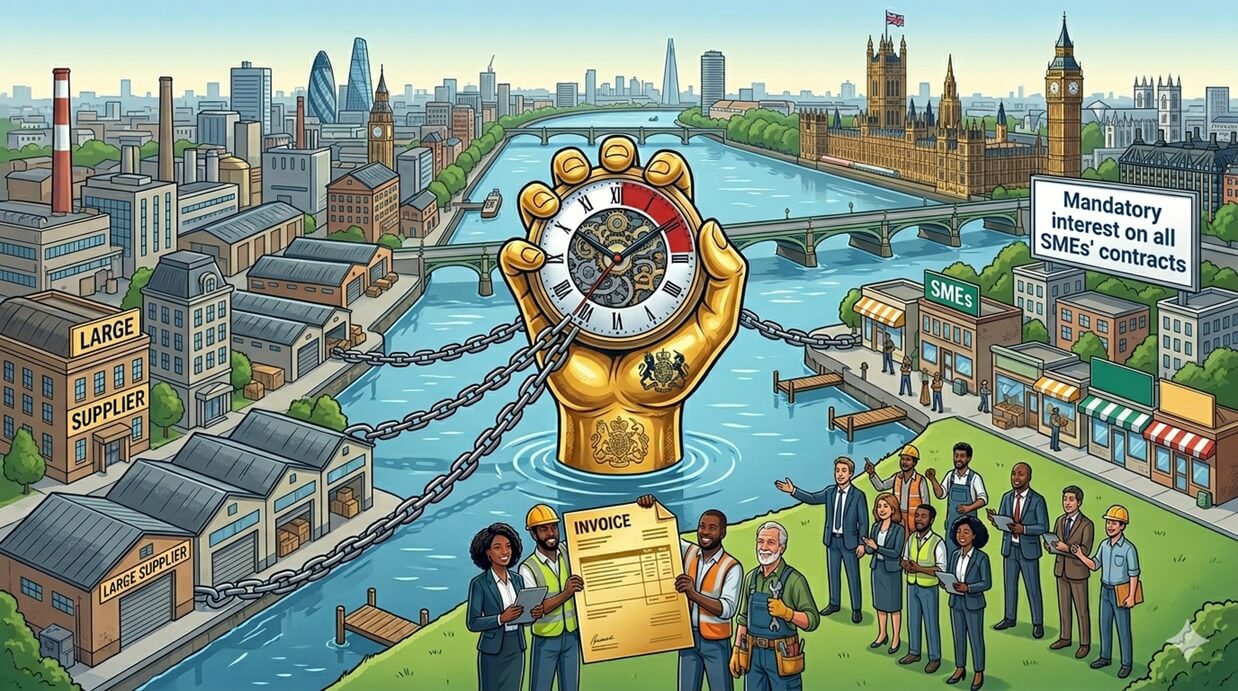
For decades, large corporations have treated their small and medium-sized enterprise (SME) suppliers as an informal source of “free credit” by delaying payments. However, the UK government has recently announced the most significant overhaul of payment legislation in a generation, signalling a shift that mirrors a growing global movement toward prompt payment and supply chain ethicality.
The Crisis: A Multibillion-Pound Drag on Growth
The scale of the issue in the UK is a microcosm of a global challenge. Late payments cost the UK economy an estimated £11bn ($14.5bn) annually, leading to the closure of roughly 38 businesses every single day. This systemic failure forces small business owners and freelancers to waste vital capital and time chasing earned income rather than investing in growth.
In the world of global public procurement, this is increasingly recognised as a “social value” risk. When small suppliers fail due to liquidity issues rather than a lack of demand, the entire supply chain loses resilience.
Core Reforms: The New ‘Gold Standard’ for the G7
Described as the toughest legislation in the G7, the UK’s new measures include several “hard” caps that will fundamentally alter commercial contracting:
60-Day Maximum Payment Cap: Large firms will be legally barred from exceeding 60-day payment terms for smaller suppliers. While global public procurement practices often aim for a 30-day gold standard, this 60-day cap provides a critical legal safety net.
Mandatory 8% Interest: All commercial contracts must now include statutory interest set at 8% above the Bank of England base rate. To illustrate, a late payment of £10,000 delayed by 60 days would result in an additional £293.15 in mandatory interest and compensation.
Board-Level Accountability: Payment performance is moving from the back office to the boardroom. Persistent late-paying companies must now publish explanations for poor performance in their annual reports, putting the issue under the scrutiny of investors and audit committees.
Linking to Global Public Procurement Practices
The UK’s move aligns with a broader international trend where governments are using their regulatory and purchasing power to enforce fair payment:
Supply Chain Resilience: Much like the EU’s Late Payment Directive, the UK’s focus is on ensuring that liquidity stress does not “cascade” through supplier networks. Global procurement leaders are increasingly shifting from cost-driven models to reliability-driven models that prioritise long-term supplier health.
Regulatory Enforcement: The UK has significantly empowered its Small Business Commissioner, granting the office authority to investigate disputes and levy fines that could reach tens of millions of pounds. This reflects a global shift toward “interventionist” procurement policies rather than relying on voluntary codes of conduct.
The Construction Sector Focus: Similar to many jurisdictions worldwide, the UK is consulting on banning “retentions”—the practice of withholding a percentage of payment until project completion—to prevent small firms from losing income due to upstream insolvency.
Strategic Implications for Procurement Professionals
For procurement and finance leaders, these reforms represent a mandatory evolution in supplier relationship management. Experts from Moody’s Analytics note that while large firms may face near-term working-capital adjustments, the long-term benefit is a more stable and sustainable supplier base.
In a globalised market where operational and geopolitical shocks are frequent, faster and more predictable payment practices reduce the likelihood of supply chain disruptions.
Conclusion
The UK government’s crackdown marks the end of an era where small suppliers are used as a source of liquidity. By mandating transparency, interest, and strict caps, the UK is setting a precedent that aligns with global best practices in responsible procurement. For businesses operating in or with the UK, the focus must now shift toward adopting the technology and infrastructure necessary to make prompt payment the default, not the exception.
Reference: How the UK Government is Cracking Down on Late Payments